

AFRAA intervention on the Panel: “Creating a sustainable African aviation industry, encompassing environmental, social and economic dimensions” at Aviation Africa Summit, 05 September
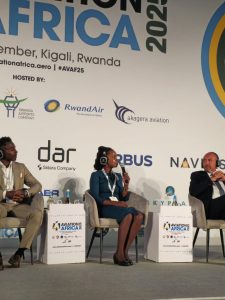
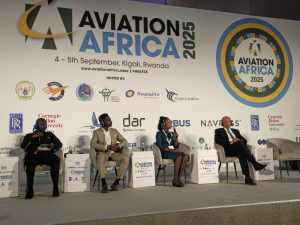

The panel focused on the critical actions that need to be done to help create a sustainable African aviation industry which encompasses environmental, social, governance and economic dimensions.
Framing Sustainability in African Aviation
- Triple focus: Sustainability in African aviation must encompass environmental (SAFs, carbon offsetting, technology, operations & infrastructure), social (jobs, inclusivity, connectivity) and economic (profitability, resilience, competitiveness) pillars.
- AFRAA’s role: Driving collaborative strategies among airlines, regulators, financiers, and manufacturers to ensure African aviation thrives.
Focus on Environmental Dimension – SAFs as the Game Changer
Maureen Kahonge, Senior Manager Business Development & Communications AFRAA highlighted the SAF Readiness Survey by AFRAA:
- Current status: AFRAA’s 2025 SAF Readiness Survey shows:
- About 80% of African airlines have no access to SAF at their operational airports.
- About 70% of African airlines say that SAF must be price-competitive with Jet A1; only 24% accept even a small premium.
- 92% are open to collaboration, and 84% are ready to join an AFRAA SAF Taskforce.
- More than half of airlines are interested in green financing solutions to support SAF adoption.
Barriers on SAF adoption highlighted were: Limited availability, high cost, regulatory gaps, and lack of technical readiness (few feasibility studies completed) and the cost challenge. SAF adoption hinges on financial viability, with jet fuel already a major cost driver (30–40% of airline OPEX), African airlines cannot absorb SAF premiums.
Sustainability requires bold regulatory clarity and regional alignment; fragmented national policies will only slow our progress. There are opportunities for Africa, the continent could achieve 0.6 million tonnes of SAF capacity by 2030 of 5–10% of projected global supply. Local feedstocks (biomass, waste, solar-powered hydrogen) make Africa well-positioned to be a regional SAF production hub.
Airlines have asked for AFRAA actions: Advocate for tax exemptions, subsidies, harmonized certification frameworks, and regional SAF production clusters to accelerate adoption. Strengthen capacity building through training programs, workshops, and technical briefs, Operationalize the AFRAA SAF Taskforce for joint procurement, knowledge sharing, and advocacy.
AFRAA’s Roadmap on Decarbonisation Pathway to Net Zero and Call to Action
AFRAA has published the AFRAA Roadmap on Decarburization Pathway to Net Zero and Call to Action which serves as a blueprint of actions that African airlines should take at the minimum towards global decarburization. It outlines key pathways that include:
- adopting Sustainable Aviation Fuel (SAF)
- investing in new technologies
- optimizing operations and infrastructure
- implementing effective carbon offsetting strategies
- developing human capital to support the transition
As the market evolves rapidly, it is crucial to remain adaptable. This coordinated effort requires active participation from AFRAA, airlines, governments, and other stakeholders to ensure that the African aviation industry not only meets global environmental targets but also remains competitive and sustainable in a rapidly evolving global market. AFRAA will continue to track airline progress through surveys to establish successes and challenges as well as take steps to address the bottlenecks.