

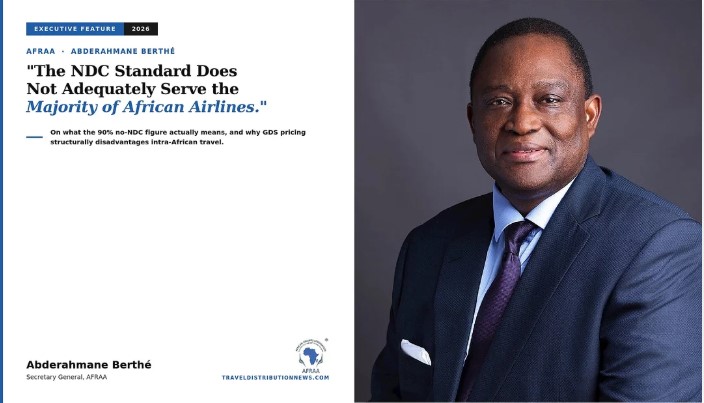
The Secretary General of the African Airlines Association on what the 90% no-NDC figure actually means, why GDS pricing structurally disadvantages intra-African travel, and what genuine adaptation of the NDC standard would require.
The statistic has been repeated across the industry for months. More than 90 percent of AFRAA member airlines have no NDC capability. The figure comes from the TPConnects-AFRAA Airline Distribution Survey 2025, published as part of the whitepaper “Africa’s Next Flight: Modern Airline Retailing Unlocked.” AFRAA and TPConnects have described the survey as gathering responses from a diverse group of African carriers, though neither party has published the exact sample size or what share of AFRAA’s full membership it represents, a gap worth noting given how widely the headline figure has travelled.
Abderahmane Berthé, Secretary General of AFRAA, does not dispute the number. He disputes what people assume it means.
“What it tells us unambiguously is that the overwhelming majority of African carriers are still transacting through legacy GDS infrastructure that was not designed with their operating context in mind,” he says. “But what the figure does not tell us is how alive African carriers are to modernisation.”
That distinction, between a lack of capacity and a lack of will, is the foundation of one of the most structurally honest assessments of African airline distribution that TDN has published.
The Number Behind the Number
The same survey that produced the 90 percent figure found that over 40 percent of African airlines are either planning or actively implementing NDC. Berthé reads that statistic as evidence of genuine appetite constrained by genuine capacity limits, not strategic indifference.
The scale problem is specific and severe. Eighty-one percent of AFRAA member airlines carry fewer than two million passengers annually. Eighty percent operate fleets of 15 aircraft or fewer. These are not organisations with large IT departments or transformation budgets sized for enterprise-grade distribution overhauls.
“The 90% figure reflects the consequences of under-resourced aviation ecosystems, not a lack of strategic will,” Berthé says.
Where the Real Barrier Sits
Asked which of the commonly cited barriers, cost, fragmentation, IT budgets, agency dependency, is the most consequential, Berthé’s answer cuts against the conventional framing.
“The most consequential barrier, in my view, is the absence of in-house technical capacity,” he says. “You can address cost through financing mechanisms, you can address market fragmentation through interline and codeshare arrangements, but the deficit of skilled digital talent within African airlines is a structural problem that takes years to resolve.”
The data supports the claim directly. Sixty percent of survey respondents reported difficulties integrating NDC with existing systems, with many airlines openly acknowledging they lack the in-house expertise to manage large-scale IT transformation.
And on the standard itself, Berthé does not equivocate.
“The NDC standard, as currently designed, does not adequately serve the majority of African airlines.”
His reasoning is structural rather than dismissive. The standard assumes sophisticated PSS infrastructure, mature IT departments, and established integrator relationships, conditions that most AFRAA member airlines do not have in comparable form. For a carrier operating six to fifteen aircraft on on-premises systems, which describes a significant share of the membership, NDC compliance is not a contained technology project. It is a wholesale transformation of commercial infrastructure.
Technology providers working in the African market tend to see the same barriers differently. Vendors building cloud-native NDC platforms argue that implementation costs have already fallen substantially in recent years, and that the remaining obstacles are increasingly organisational, training, change management, internal buy-in, rather than purely technical or financial. TPConnects, AFRAA’s own whitepaper partner, has made a version of this case publicly, framing modern retailing as a matter of control and agility that airlines can access once they commit to the transition. Berthé’s view does not reject that framing outright. It insists the commercial models built around it still need to bend toward African carrier realities rather than assuming readiness that, for most of the membership, does not yet exist.
That does not lead him to call for abandoning the standard. The ambition behind NDC, direct distribution, richer content, dynamic pricing, offer and order management, is one he endorses. What he is calling for is genuine adaptation: modular, phased implementation pathways for smaller carriers, cloud-native solutions that avoid expensive on-premises integration, and commercial pricing models calibrated to the revenue base of smaller operators rather than priced on the assumption of large-carrier volumes.
The barrier he considers most misunderstood, by contrast, sits outside the airline entirely. Technology vendors arriving on the continent consistently underestimate how deeply embedded the travel agent community remains in GDS workflows.
“The incentive structures, the booking tools, the settlement mechanisms, all of it is built around existing intermediary channels,” he says. “Any NDC adoption strategy that does not invest in agent training and transition support is building on an incomplete foundation.”
His broader point is about framing itself. African airlines are not simply lagging on a universal adoption curve that everyone else is following correctly. They are navigating a distinct commercial environment that requires adapted solutions, timelines, and support models, and the industry’s credibility with African carriers depends on acknowledging that rather than treating Africa as a delayed version of mature markets.
What AFRAA Can Actually Do
Berthé is specific about AFRAA’s role, organising it into three functions: policy, knowledge-sharing, and partnership facilitation.
On policy, AFRAA’s position is that the African operating context needs direct representation in how NDC standards are developed and maintained, rather than standards being designed around large full-service carriers in mature markets and handed down to everyone else.
On knowledge-sharing, the joint whitepaper with TPConnects is offered as a model AFRAA intends to repeat, using its workshops, masterclasses, and the AFRAA Aviation Stakeholders Convention as platforms for structured exchange between member airlines.
On partnership facilitation, AFRAA’s value is in giving airlines collective negotiating leverage they could not access individually, helping identify credible technology partners and ensuring vendors deliver genuine value rather than extracting from carriers with limited bargaining power.
What he is explicit about rejecting is generic capacity building.
“African airlines do not need more seminars,” he says. “They need technical assistance that is embedded, practical, and measurable.”
The Pricing Problem Nobody Talks About
The most concrete and quotable section of Berthé’s responses concerns intra-African connectivity, and the way current distribution infrastructure actively works against it.
“The GDS charges for a Nairobi-Mombasa booking are similar to a Nairobi-London booking even if the fare on the shorter trip is a small fraction of the longer flight,” he says. “This makes the task of growing intra-African connectivity difficult.”
The deeper structural problem goes beyond pricing mechanics. Berthé describes how African travellers searching for routes between two African cities frequently encounter fares priced through European or Middle Eastern hubs, a direct artefact of how GDS infrastructure has historically routed and priced African itineraries.
“The technology is not neutral,” he says. “It encodes a particular model of how African air travel is organised, and that model does not serve African travellers or African airlines.”
The consequence extends to the partnerships airlines are actively trying to build. Interline and codeshare arrangements between African carriers, essential to constructing genuine intra-African networks, are often difficult to surface through existing booking channels. An agent searching for a connection across two African carriers may simply not find it, or find it priced uncompetitively, because the distribution infrastructure was never built to present those options clearly.
Berthé’s specification for what infrastructure genuinely built for intra-African travel would require is precise: visibility and bookability for interline, codeshare, and more sophisticated partnership models between African carriers; payment systems that reflect African market realities, including mobile payment prevalence and limited card penetration; and accessibility for the travel trade across the continent, including smaller agencies in markets with thin GDS coverage. This is the explicit ambition behind AFRAA’s Xchange initiative.
The Realistic Timeline
On how quickly the 90 percent figure might shift, Berthé describes his outlook as cautiously optimistic, with clear eyes about the pace of change.
The survey data offers a concrete basis for that caution. Eighteen percent of carriers plan to complete their NDC transition within a year. A further 28 percent expect to do so within two to three years. If those intentions hold, the landscape shifts materially within the timeframe TDN asked about. Berthé’s caveat is one every airline transformation programme eventually confronts: intentions do not always survive budget cycles and operational pressure.
He identifies three conditions necessary for meaningful change. Technology must become more accessible, both technically and commercially, through cloud-based modular solutions priced for smaller carriers rather than requiring extensive PSS integration work. The travel agency channel must be activated through training, incentive realignment, and B2B portal solutions, since airlines face genuine transition risk as long as the majority of their revenue flows through agents who are not NDC-capable. And financing and technical assistance from development finance institutions and multilateral bodies need to extend to digital commercial infrastructure, not only physical infrastructure.
On where responsibility sits, Berthé distributes it deliberately. Technology vendors are responsible for designing and pricing solutions that serve smaller carriers rather than only global tier-one accounts. Governments and regulators are responsible for creating investable environments. AFRAA’s responsibility is convening, advocating, and facilitating, a role he commits to continuing through the Xchange project specifically.
The Bottom Line
The question is no longer whether African airlines want modern retailing. The data Berthé cites settles that. Over 40 percent of AFRAA members are already planning or implementing NDC, and nearly half of those expect to complete the transition within three years.
The question is whether the industry’s technology and commercial models are willing to adapt to African realities, rather than expecting African carriers to adapt to them. A pricing structure that charges the same for a short regional hop as a long-haul flight, a standard built around the IT maturity of large carriers, a distribution architecture that routes African travellers through distant hubs by default: none of that is a failure of African ambition. It is a failure of infrastructure built somewhere else, for someone else, and exported without adjustment.
Berthé’s case is that the adjustment is overdue, and that AFRAA intends to keep making it.
Abderahmane Berthé is Secretary General of the African Airlines Association (AFRAA), the trade association representing African airlines.
Travel Distribution News covers the business of airline distribution, NDC, GDS dynamics, payments, and emerging markets. Subscribe at traveldistributionnews.com